

News

AERONAUTICAL SAFETY IN THE IA ERA: GOING BEYOND THE LIMITS OF EXCEL
by Christian Do Cao, IT expert, pilot instructor and founder of AIMIS, publisher of QUOTES-SGS and SAFE & RULES solutions
THE FINDING
The aeronautical industry operates within a regulatory framework imposed by the European Aviation Safety Agency (EASA). At the heart of these requirements is the Management System, built around the Safety Management System (SMS) and the Compliance Monitoring System (CMS). These systems maintain approvals, but their day-to-day management poses a practical problem familiar to many organizations: the use of unsuitable office automation tools. This article examines this situation and presents solutions for more effective management.
THE EASA MANAGEMENT SYSTEM
Today, the Management System is based on two complementary components:
Safety management according to EASA
SMS represents a proactive approach to safety, aimed at identifying and mitigating risks before they become incidents. It is organized around four axes:
- safety policy and objectives ;
- hazard identification and risk management ;
- safety assurance through performance monitoring ;
- safety promotion and communication.
Human and organizational factors (HOF) are now fully integrated into the SMS, as they directly influence system performance.
Compliance Monitoring System (CMS)
The CMS ensures the organization's ongoing compliance with regulatory requirements and its internal procedures. It includes:
- a program of audits and inspections;
- processes for detecting and correcting non-conformities;
- a document management system ;
- continuous improvement mechanisms.
These two pillars are not independent: the results of audits feed into risk assessment, while the analysis of safety events can reveal gaps in compliance.
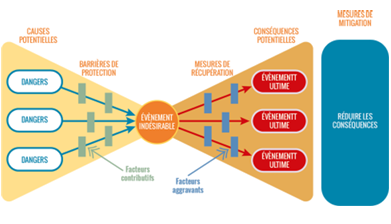
The BOW TIE risk management model.
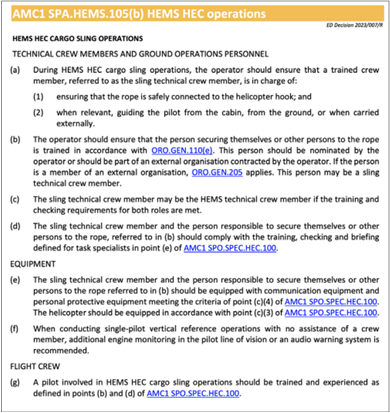
Extract regulatory points relating to HEMS HEC operations, to be presented point by point to the authorities, providing evidence for each item.
The HEMS HEC corresponds to helicopter emergency medical rescue operations involving the use of a winch to hoist people or equipment into difficult-to-access environments.
The central role of the management system
The Management System is not just an administrative formality. It forms the basis for EASA approval, and is made mandatory by several European regulations:
- maintenance organization (Part-145) ;
- CAMO (airworthiness management) ;
- CAD (combined maintenance + airworthiness): the management system is simplified with no formal SMS obligation;
- air operator (AOC) ;
- training organization (ATO): SMS is mandatory if training for CPL/ATPL or CAT operators;
- ANSP (air navigation service provider) ;
- certified airport (ADR) ;
- design organization (DOA Part 21 J) & production organization (POA Part 21 G): changes are planned.
In France, these approvals are supervised by two main bodies:
- the DSAC (Direction de la Sécurité de l'Aviation Civile), a national department of the DGAC, for the supervision of air operators, training organizations, aerodromes and air navigation service providers;
- OSAC (Organisme pour la Sécurité de l'Aviation Civile), a government-authorized body, for oversight of production, maintenance and CAMO (Continuing Airworthiness Management Organisation) organizations.
Audits carried out by these authorities examine the efficiency of the Management System. A failure in this area may result in :
- findings of non-compliance leading to activity restrictions;
- temporary suspension or withdrawal of approval ;
- an impact on reputation with commercial consequences;
- an increased risk of incidents or accidents.
In this context, a solid Management System represents not only a regulatory obligation, but also a competitive advantage.
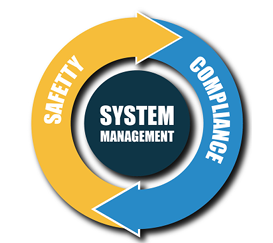
THE MANAGEMENT SYSTEM
Regulations establish a structuring framework by laying down minimum safety requirements. The Safety Management System (SMS) complements this framework by identifying risks specific to the organization and implementing appropriate internal measures. In this way, the SMS compensates for the limitations of the regulatory framework and creates additional barriers, enabling safety to be adapted and reinforced on an ongoing basis over and above regulatory obligations alone.
EXCEL FOR SPECIFIC REQUIREMENTS
Despite the importance of the Management System, a surprising fact persists: the predominance of Excel as the main tool for managing Safety and Compliance activities. This phenomenon can be explained by :
- the availability of Excel in all business environments;
- the apparent flexibility to create follow-up tables;
- no acquisition costs (already in the office suite);
- no initial investment in training.
However, this approach generates operational difficulties which are amplified by the growing complexity of regulatory requirements. Limits to safety management In the safety field, Excel has its limits:
- difficulty establishing links between different events ;
- limitations in trend analysis on large amounts of data ;
- lack of automatic notifications and workflow ;
- risk of errors during manual handling ;
- inability to integrate feedback into a structured database.
A concrete example: when a safety event occurs, the Safety Manager often has to manually consolidate information between several Excel files - one for initial reporting, another for action follow-up, and a third for statistics. This fragmentation increases the risk of error and complicates cross-functional data analysis, which is essential for detecting weak signals.
Management constraints Compliance
For compliance monitoring, the challenges are similar:
- difficulty in keeping regulatory references up to date ;
- complexity of corrective action follow-up ;
- no link between audit findings and regulatory requirements ;
- cumbersome report generation ;
- risk of loss of history and traceability.
The Compliance Manager is faced with a double challenge: on the one hand, keeping up with the constant changes in EASA regulations, and on the other, ensuring that the organization applies these rules. With Excel, each update to the repository requires manual intervention on multiple files, with risks of desynchronization and inconsistency.
Disproportionate administrative burden
Using Excel for these activities creates an administrative burden that diverts resources from their primary mission. Safety Managers and Compliance Managers find themselves caught in a cycle of :
- Copy and paste between files ;
- manual formatting for reports ;
- re-capturing information already available ;
- laborious data consolidation ;
- manual consistency check.
This situation leads to a paradox: safety and compliance profes sionals spend more time managing administration than analyzing and improving the system. The time devoted to preparing meetings and formatting data for audits encroaches on that which should be devoted to risk analysis or the implementation of preventive actions.
Impact on the organization
This has a direct impact on the system's overall efficiency.
Limited reactivity : Cumbersome administrative procedures slow down the processing of safety events. Between the time an incident is reported and the time concrete actions are defined and followed up, precious time can elapse. This latency can be critical when it comes to preventing the recurrence of similar events.
Loss of global vision: The fragmentation of data between different Excel files makes it difficult to obtain a global vision. Correlations between events, essential to understanding systemic risks, become almost impossible to establish on large volumes of data.
Vulnerability to audits - Faced with auditors, demonstrating compliance becomes a laborious exercise. Searching for evidence, scattered across multiple files, consumes a considerable amount of time and increases the risk of certain aspects not being properly documented.
Team demotivation: Safety and compliance professionals, often passionate about their work, find themselves confined to repetitive administrative tasks. This can lead to a gradual loss of motivation and, paradoxically, less focus on real safety issues.
TO SPECIALIZED TOOLS
Faced with these challenges, the move towards specialized solutions is becoming a strategic necessity. This is the background to the development of the Safe & Rules application, designed for Safety Managers and Compliance Managers in organizations subject to EASA regulations.
This solution adopts an integrated approach that reflects the operational reality of modern systems, where Safety and Compliance constantly interact.
It is based on several principles.
Integration of regulatory standards
The application directly integrates EASA requirements and automatically keeps them up to date, making it possible to :
- automatically link audit findings with the corresponding requirements;
- ensure traceability between activities and their regulatory basis;
- generate up-to-date compliance matrices.
This native integration eliminates the need to manually maintain separate repositories, and ensures that the organization is always working with the latest version of regulatory texts.
Workflow management
Unlike static spreadsheets, a specialized solution automates workflows:
- notification of the players involved, depending on the event ;
- follow-up of corrective action deadlines ;
- escalation in the event of failure to resolve within the deadline ;
- electronic stage validation.
Automating workflows not only saves time, but also ensures that each step in the process is correctly executed and documented, without the risk of oversights or short-circuits.
Integrating artificial intelligence
What's interesting is that Safe & Rules makes it possible to feed AIs with relevant information, while respecting confidentiality and easily injecting results after validation (by humans).
Safe & Rules lets you interact with an AI assistant, which processes time-consuming tasks upstream (mass processing with complex references, maintaining consistency and relevance). The system provides for validation by the teams and enables results to be easily re-injected into Safe & Rules.
To illustrate the use of AI: it's like using an autopilot to gain time to prepare for a safe approach, and resuming manual piloting for landing. This approach harnesses the potential of AI as an assistant, without ever replacing the judgment of safety and compliance professionals.
Reduced administrative burden
By automating repetitive tasks, the application enables professionals to concentrate on their core business:
- automatic report generation ;
- elimination of copy/paste and re-typing ;
- direct import of existing data ;
- complete history retention.
This reduction in the administrative burden frees up valuable time that can be reinvested in higher value-added activities, such as in-depth root cause analysis or the development of new preventive measures.
Testimonials and feedback
An SMS manager from a HEMS operation comments: "Since adopting Safe & Rules, our risk mapping for our EMS helicopter operations has improved significantly. The DSAC inspectors appreciated our ability to link events, risks and mitigation actions. The few observations we received were easy to resolve, thanks to the system's traceability.
IN SUMMARY
The evolution of Safety & Compliance management tools represents a change in the very approach to aviation safety and compliance. By freeing professionals from administrative tasks, solutions such as Safe & Rules enable them to refocus attention on the essentials: the continuous improvement of safety and quality of operations.
This transformation becomes particularly necessary in a context of ever-changing regulations. Organizations that overcome the limitations of generalist tools and adopt specialized solutions will gain administrative efficiency and develop an advantage in terms of resilience, regulatory agility and operational security.
Faced with the challenges of modern aviation, putting technology at the service of safety becomes essential, not as an end in itself, but as a means of freeing up human potential for what cannot be automated: analysis, anticipation and innovation in aviation safety.
As the aeronautical engineer Theodore von Kármán reminded us: "A scientist studies what exists, an engineer creates what has never been." In the field of aeronautical safety, it's time to create the tools that will enable us to achieve unprecedented levels of safety.
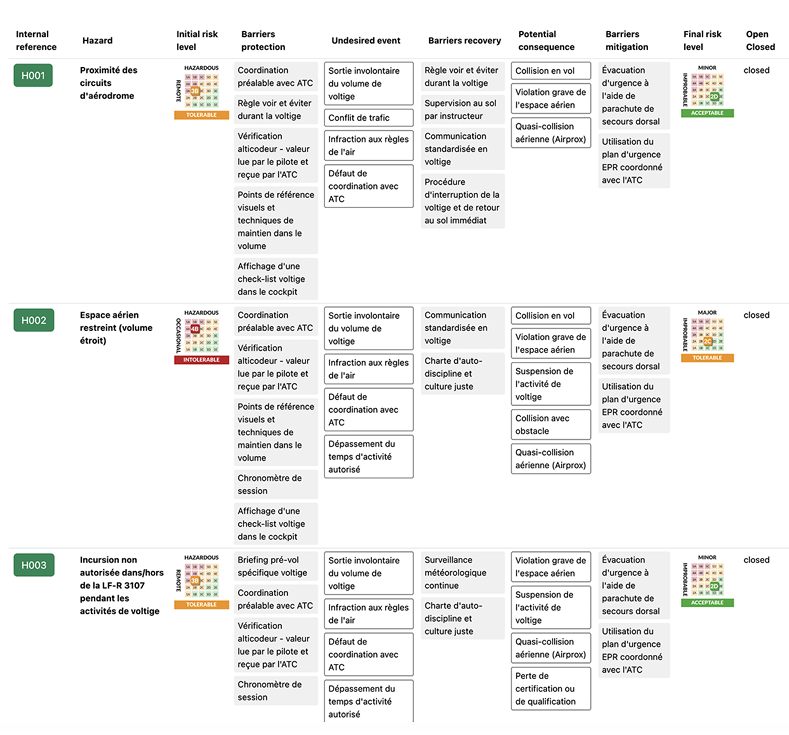
Example of a BOW TIE risk map for an aerobatic activity.
This mapping was developed using Safe & Rules software, which provides a visual structure for risks, protection, recovery and mitigation barriers. Safe & Rules also integrates the management of all applicable internal and regulatory references, thus facilitating monitoring, risk assessment before and after the implementation of barriers, and the steering of the safety management system.


No comment
Log in to post comment. Log in.