

News
KNOWLEDGE TRANSFER: THE SPECIAL CASE OF NUCLEAR POWER
From 1981 to 2004, the French government, in association with the ecologist party, pursued a latent policy of abandoning nuclear power, authorizing no reactor orders. This policy culminated in Ségolène Royal's announcement of the closure of 24 reactors in November 2011, and was accompanied by the appointment to key energy posts of political figures with limited technical skills, but politically able to follow these instructions.
Against this backdrop of the nuclear phase-out, EDF is set to sell off the engineering units that successfully built the 58 French power plants that supply around 70% of our electricity year after year. Likewise, most industrial companies, with no orders for over twenty years and no visibility for the future, will disappear or move in other directions. French energy gems will be squandered. Alstom's turbines will be sold off to General Electric, and Creusot Loire's forges, with their empty order books, will be given to Bolloré for a pittance.
Try to imagine, dear reader, what the French aeronautics industry would be like after thirty years without a single aircraft order!
This global loss of skills will be on full display during construction of the Flamanville EPR. EDF is going to recreate an engineering unit of around 1,000 people, and work is going to start with announcements of delivery in 2012. It will eventually be 2025. The two EPRs sold to China will start construction two years later, and will be in operation by 2018 and 2019. De-dustrialization, loss of skills, etc...
Measures have been taken by EDF: organization of new engineering teams, creation of welder/pipefitter schools, recall of retirees, etc... Let's hope that these measures will provide an opportunity for standar disation and positive evolution for the successive EPR 2 worksites to come. In this mess, let's mention two examples: the turbines sold for 10 billion euros will be bought back for 20 billion by EDF, and Bolloré will be paid 170 million euros for
sell the forges to Framatome. In this case, it's the taxpayer who pays, since the failed privatization of EDF, and other cataclysmic political measures, will have led the State to have to recapitalize it with taxpayers' money. Many billions lost, for the unfortunate taxpayer, but not lost for everyone.
In 1997, Lionel Jospin shut down the Superphenix plant, which had been operating perfectly for a year. This reactor had a remaining lifetime of over 50 years and produced 1,200 MWe. France is a rich country for such waste. All this just to get a majority with the votes of the ecologist party.
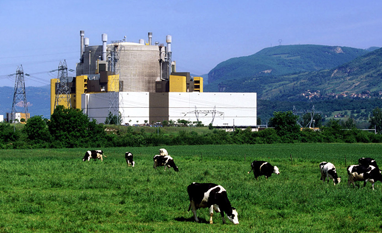
This reactor was part of a line established in 1960 with the Rapsodie, Phenix and Superphenix reactors. These so-called fast reactors work with the waste produced by the water-cooled reactors that make up our current fleet. With the waste currently available and stored in France, this technology could produce our energy for thousands of years. It would ensure France's sovereignty, as there would no longer be any need for uranium mines and enrichment plants. France was the world leader in this field, necessary for the future, for our future [1]. Reactors of this type are currently in operation or under construction in Russia, Japan, China and India. They would be all the more useful to us, given that uranium prices are soaring, and are far from over.
In the field of fast reactors, the fall was severe. Thousands of people working on this technology disappeared. Most of the research centers were closed. As for the manufacturers who worked in this field, their workshops were closed or converted. So there's not much left, apart from a heap of documents in the dusty archives of various stakeholders (CEA, EDF, Framatome and various industrialists).
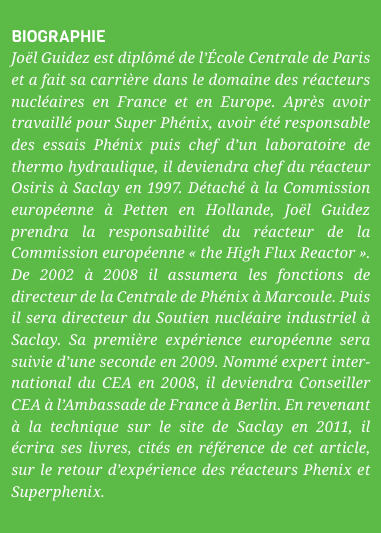
How can this voluminous and messy knowledge be passed on to future generations? The author of these lines decided to devote the last few years of his professional life to writing two books summarizing what had been learned from the construction and operation of the Phenix and Superphenix reactors [2-3]. In both cases, we decided to take a thematic approach to feedback. What did we learn about neutronics, fuel, materials, components, chemistry, thermo-hydraulics and so on? Readers interested in any one of these topics can refer to it for a twenty-page summary of what they need to know about the chosen theme.
It's a bit as if, after the A 380 was shut down, we decided to write a book of feedback on all aspects of the production of this aircraft, and everything we learned, theme by theme, from this industrial experience.
The approach is fractal. Two pages at the beginning of the book summarize the main points to remember about these reactors. Then the chapters unfold. If you want to learn more about a chapter, there are open references that you just have to read. And these references will introduce others that are more and more precise. But this reading order is essential if you are to acquire the knowledge you need.
These two books are currently bedside reading for those who continue to work on this path to the future. Published in 2000 copies, they have been republished and translated into English. They are now virtually sold out.
That said, even these indispensable books won't solve everything for the future. First of all, technology is evolving, and certain points from the past are no longer usable. Secondly, while an overview is necessary, the "details" and the operator's knack are no longer available. When it comes to materials, for example, it's not enough to know their composition. It also means knowing how they are manufactured (ingots, etc.) / what impurities are allowed / how they are treated (hardened, de-tensioned, etc.) / how they are machined or used (rolling? foundry?) / and all the welding processes (TIG, MMA, MAG, Plasma, Laser, etc.) with the corresponding composition of the welding wires, etc...
Secondly, modes of transmission have changed. Today, we're more interested in visual (tutorials) or interactive (MOOCs) methods of transmission than in hard-to-follow "coffee table books". Finally, during an oral speech, it is estimated that the listener retains meta-messages (such as "it's good or it's not good") and only 5% of the message itself. What about reading a book? Chapter-by-chapter training sessions are necessary to increase the memorization rate. Meetings and joint work with experienced people are also highly instructive. Only a combination of all these actions will enable a gradual transfer of knowledge to a team.
In this context, AI presents both a great advantage for the future and a potential danger. The advantage of AI is that, by definition, it's a huge data-gobbler (the work I did re-reading large volumes of data for Phenix alone took me at least a year). That said, once the data has been entered, we theoretically have a tool capable of answering all questions, from general data to very precise implementation details. The fractal aspect is automatically handled by the machine.
One advantage/disadvantage is that AI tools can, by their very nature, speak in any language. The knowledge protection aspect becomes vital for this type of product. An important limitation is data verification. When I carried out this exercise, I came across contradictory data several times, for various reasons: experts not in agreement, project evolution or simply error. Verification has to be carried out, and it requires skill. Finally, there is the advantage/disadvantage of the tool's power, which becomes a kind of oracle answering all questions. This can be an easy solution that prevents users from learning and assimilating knowledge.
In conclusion, the nuclear industry is unfortunately an area where agile knowledge transfer techniques need to be applied. Technical knowledge must be extracted, then classified by theme and analyzed in a fractal manner. A "bedside book" giving an in-depth view of a subject is always a necessary intellectual tool. But the complementary use of interactive methods, MOOCs, dedicated and future courses, and an AI consultation system would be very useful.
References
[1] Fast reactors. "Le nucléaire du futur" J. Guidez, Éditions EDP sciences, 2024. EAN 978.2.75983.598.0
[2] Phenix. Le retour d'expérience ; J Guidez, Éditions EDP sciences, reprint 2013. EAN 979.1.09204.105.7
[3] Superphenix. Les acquis techniques et scienti f iques ; J. Guidez, Atlantis Press, reprint 2017. EAN 978.9.46252.135.3




No comment
Log in to post comment. Log in.